

Contents
Introduction
Welcoming a new baby is a special time for any family. For foreign residents in Japan, it also comes with several government procedures, and some of them have strict deadlines. A baby born in Japan to two foreign parents does not get Japanese nationality automatically, so your child also needs their own status of residence (visa) to stay in Japan.
This guide explains the three main procedures, the deadlines, the documents you need, and other benefits you should apply for.
At a glance
| # | Procedure | Deadline | Where |
|---|---|---|---|
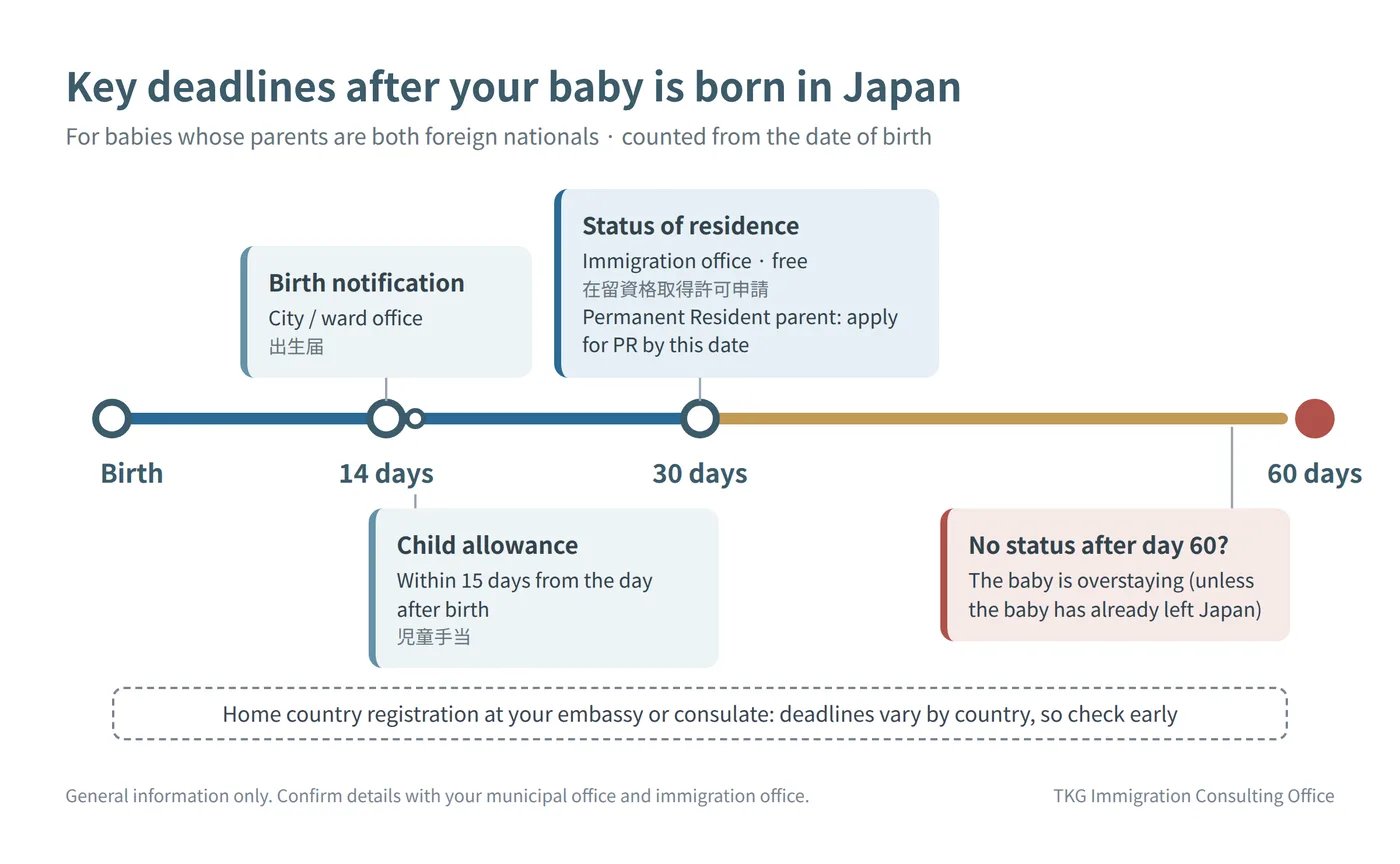
| 1 | Birth notification (出生届, shussei todoke) | Within 14 days of birth | City, ward, town, or village office |
| 2 | Application for the baby’s status of residence (在留資格取得許可申請) | Within 30 days of birth | Regional immigration office for your address |
| 3 | Birth registration with your home country | Varies by country | Your country’s embassy or consulate in Japan |
For the birth notification, the day of birth counts as day 1. Don’t leave any of these to the last day.
Note: If one parent is a Japanese national, your child is generally a Japanese national and does not need a status of residence. The birth is recorded in the Japanese parent’s koseki (family register). This article focuses on babies whose parents are both foreign nationals.
Step 1: Submit a birth notification (within 14 days)
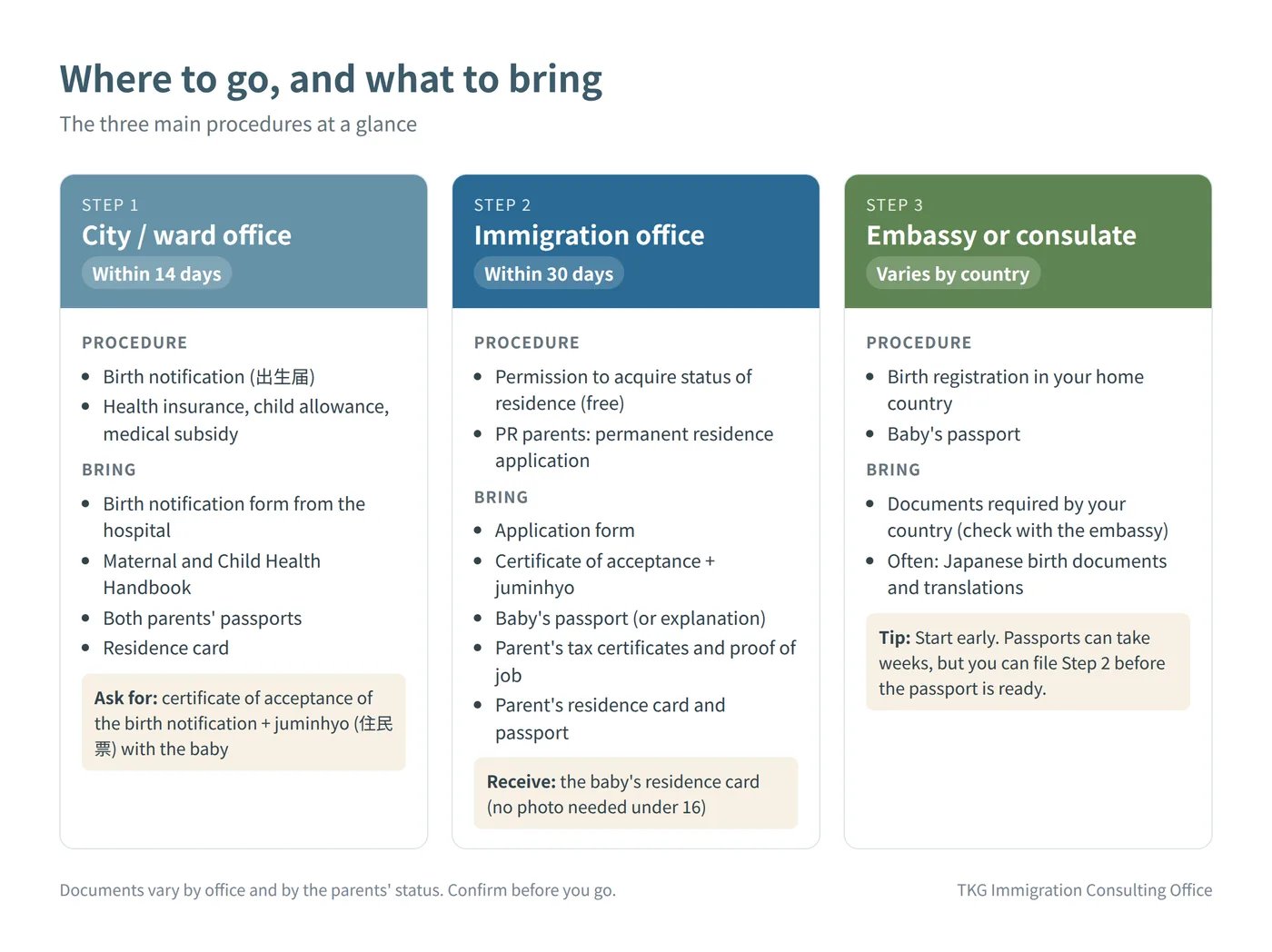
Everyone who gives birth in Japan, including foreign nationals, must submit a birth notification to a municipal office within 14 days of the birth.
Where to submit
Any one of the following municipal offices:
- The office for the place where the baby was born
- The office for the place where you live
What you need
- Birth notification form (出生届). The hospital usually gives you this form. The right half, the birth certificate (出生証明書), is filled in and signed by the doctor or midwife.
- Maternal and Child Health Handbook (母子健康手帳, boshi techo)
- Passports of both parents
- Residence card of the person submitting the notification
- Any other documents your municipality asks for
Tips
- Decide the baby’s name first. For foreign nationals, the name is usually written in katakana, together with the alphabet (the original spelling). Chinese and Korean nationals may be able to use kanji, but only characters approved for names in Japan.
- Choose the name carefully. The name should match what you will register with your home country and on the baby’s passport. Different spellings can cause problems later.
- Ask for two important documents at the same visit. You will need them for the immigration application in Step 2:
- Certificate of acceptance of the birth notification (出生届受理証明書, shussei todoke juri shomeisho)
- Certificate of residence (住民票, juminhyo) listing all household members, including the baby
Once the birth notification is accepted, your baby is registered as a resident of your municipality. Without it, you cannot get health insurance for the baby or apply for the baby’s status of residence.
Step 2: Apply for your baby’s status of residence (within 30 days)
This is the step many foreign parents miss.
Under Japan’s Immigration Control Act, a foreign baby born in Japan may stay in Japan for up to 60 days after birth without a status of residence. If the baby will stay in Japan longer than that, you must apply to immigration for permission to acquire status of residence within 30 days of birth.
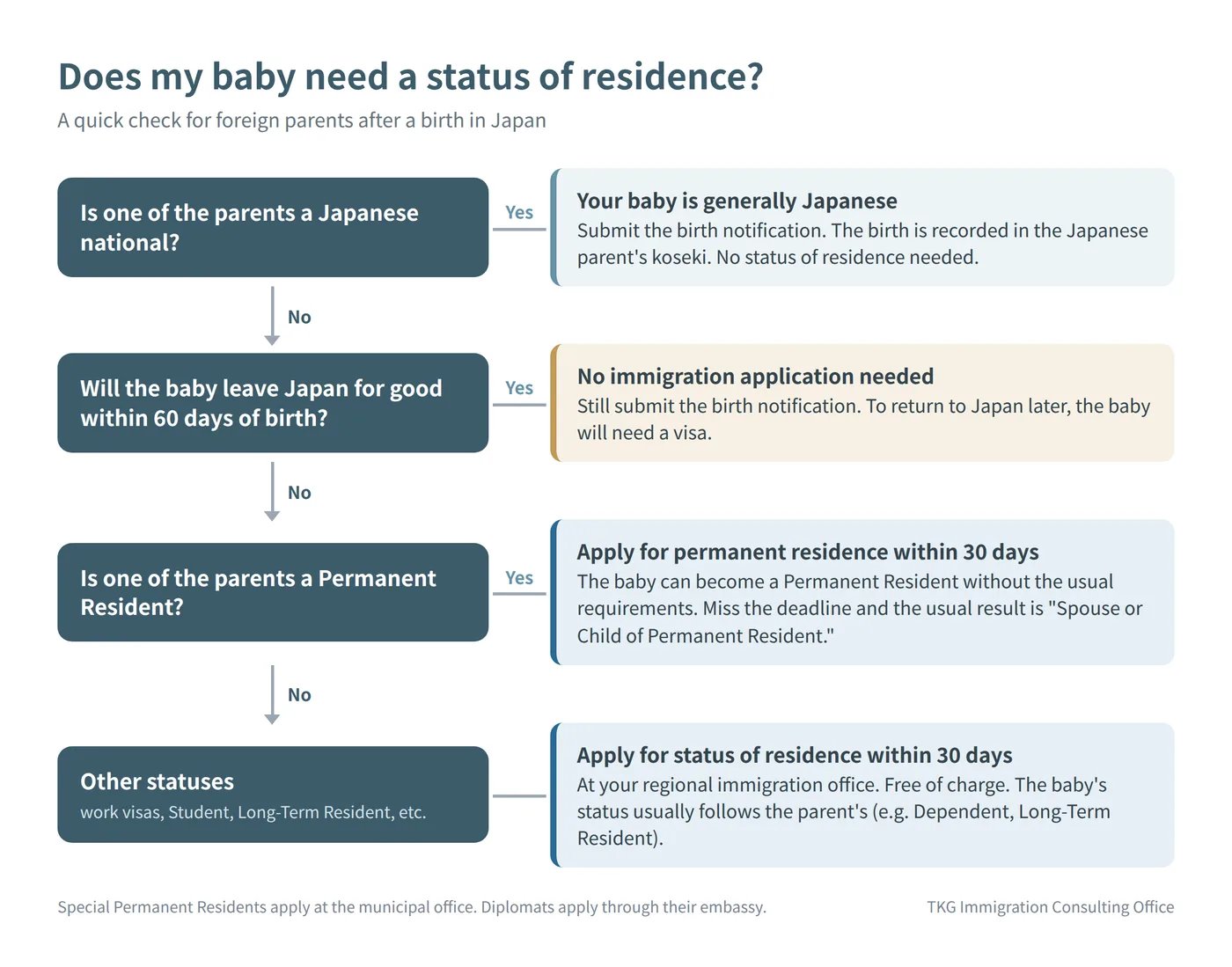
If you do not apply and the baby stays in Japan beyond 60 days, your baby will be staying illegally (overstaying). This can cause serious problems for your whole family’s future visa applications.
Where and how to apply
- Where: The regional immigration office (or branch office) that covers your address
- Who applies: A parent or legal guardian usually applies on the baby’s behalf. A registered gyoseishoshi (administrative scrivener) or lawyer can also submit the application for you.
- Fee: Free. There is no fee for this application.
What you need
- Application for permission to acquire status of residence (在留資格取得許可申請書)
- Questionnaire, if your immigration office asks for one
- Certificate of acceptance of the birth notification (original)
- Certificate of residence (住民票) listing all household members, including the baby (original, issued within the last 3 months)
- The baby’s passport, or a written statement explaining why the passport has not been obtained yet
- Tax certificates of the supporting parent: the taxation certificate (課税証明書) and tax payment certificate (納税証明書) showing annual income and tax paid (originals, issued within the last 3 months)
- Proof of the supporting parent’s occupation, such as a certificate of employment, company registration, or certificate of enrollment
- Letter of guarantee (身元保証書), only for certain residence statuses of the parent
- Residence card and passport of the supporting parent (to show at the counter)
Required documents can differ depending on the parents’ status of residence and the immigration office. Check with your immigration office or a professional before you go.
Don’t have the passport yet? Getting a passport from your embassy can take weeks. You do not need to wait for it. Apply within 30 days with a statement explaining why the passport is not available yet, and show the passport later when you collect the residence card.
What status of residence will my baby get?
Your baby’s status usually depends on the parents’ status. Common examples:
| Parent’s status of residence | Baby’s usual status |
|---|---|
| Work visas (e.g. Engineer/Specialist in Humanities/International Services, Business Manager, Skilled Labor), Highly Skilled Professional, Student | Dependent (家族滞在) |
| Permanent Resident | Spouse or Child of Permanent Resident (永住者の配偶者等), or Permanent Resident if you apply for permanent residence within 30 days of birth (see below) |
| Long-Term Resident | Long-Term Resident (定住者) |
| Designated Activities (e.g. dependents of certain Designated Activities holders) | Designated Activities (特定活動) |
| Special Permanent Resident | Special Permanent Resident (apply at your municipal office, not immigration) |
| Diplomat or Official | Diplomat or Official (procedure through your embassy or consulate) |
If a parent’s status does not normally allow family members to join (for example, some Specified Skilled Worker (i) or Technical Intern Training cases), the situation is more complicated. Please consult immigration or a professional as early as possible.
Children of Permanent Residents
If one of the parents is a Permanent Resident, the baby may be able to get Permanent Resident status directly, as long as you apply for permanent residence within 30 days of birth. This is a special route: the baby does not need to meet the usual requirement of years of residence in Japan.
The parents’ situation is reviewed
Permanent residence is not automatic. Because a newborn has no record of their own, immigration mainly looks at the parents who support the child. Points that are typically reviewed include:
- Stable income: whether the family can support the child financially
- Taxes: whether the parents have paid resident tax and other taxes properly and on time
- Pension and health insurance: whether the parents have paid public pension and health insurance premiums on time
- Compliance with immigration rules: for example, whether the parents have made required notifications (such as address or employer changes)
- Guarantor: a guarantor (身元保証人), usually a Japanese national or Permanent Resident, is generally required
Late or unpaid taxes or premiums can lead to a denial, even if the parent is already a Permanent Resident. Since 30 days go by quickly, it is a good idea to gather the parents’ documents before the birth, such as tax certificates, pension records, and health insurance documents.
The review can take longer than the regular status application. If permanent residence cannot be granted, immigration may suggest applying for the “Spouse or Child of Permanent Resident” status instead. In that case, your child can still apply for permanent residence later.
If you miss the 30-day window, your child will normally receive the “Spouse or Child of Permanent Resident” status instead and must meet the regular requirements to apply for permanent residence later. For this reason, the 30-day deadline is especially important for Permanent Residents. Unlike the regular status application, a fee applies to a permanent residence application, so check the current amount before you apply.
After permission is granted
Your baby will receive a residence card (在留カード) if the period of stay is longer than three months. Children under 16 do not need a photo. Keep the residence card with your baby’s passport, and remember to renew your child’s status of residence before it expires, just like your own.
Traveling abroad soon after birth
- If you and your baby plan to leave Japan permanently within 60 days of birth, you do not need to apply for a status of residence.
- If you want to travel and come back to Japan, get the baby’s status of residence and residence card first. After that, your baby can use the special re-entry permit (みなし再入国許可) just like other residents. If your baby leaves Japan without a status of residence, they will need a visa to enter Japan again.
Step 3: Register the birth with your home country
Many countries require the birth of their nationals abroad to be reported to their embassy or consulate. Procedures, documents, and deadlines differ widely by country. Some countries accept the birth notification through the embassy, while others require documents to be translated or authenticated.
If you do not register the birth with your home country, your child’s existence may not be officially recorded there. This can cause problems later when your child needs a passport, or when they get married, study, or work in your home country.
Tip: Contact your embassy or consulate as soon as possible after the birth. You often need this registration to get your baby’s passport, which you will also need for immigration.
Other procedures after your baby is born
Besides the three main procedures, don’t forget these. Many municipalities let you complete them on the same day you submit the birth notification.
Health insurance
- National Health Insurance (国民健康保険): If you are enrolled in National Health Insurance, add your baby at your municipal office.
- Employee health insurance (社会保険): If you are covered through your employer, ask your company to add your baby as a dependent.
After you enroll, you will receive a health insurance card for the baby, or its replacement under the My Number system. You need this for check-ups and medical treatment.
Child allowance (児童手当)
Parents of children living in Japan, including foreign nationals, can receive a monthly child allowance. Apply at your municipal office within 15 days of the day after the birth. If you apply late, you may lose payments for the months before your application. Public servants apply through their workplace.
Medical expense subsidy for children
Most municipalities cover all or part of children’s medical costs. Register at your municipal office to receive a medical subsidy certificate for your baby.
Childbirth lump-sum allowance (出産育児一時金)
If you are enrolled in Japanese public health insurance, you can generally receive a lump-sum childbirth allowance (currently ¥500,000 per baby in most cases). In many cases, the payment goes directly to the hospital. Check with your hospital and your health insurance provider.
Health check-ups and vaccinations
Your municipality will send information about infant health check-ups, home visits by public health nurses, and vaccinations. Many offices give you this information when you submit the birth notification.
Quick checklist
- ☐Birth notification submitted within 14 days
- ☐Certificate of acceptance of the birth notification received
- ☐Certificate of residence (住民票) including the baby received
- ☐Baby added to health insurance
- ☐Child allowance applied for within 15 days
- ☐Medical expense subsidy registered
- ☐Birth registered with your embassy or consulate
- ☐Baby’s passport applied for
- ☐Application for the baby’s status of residence submitted within 30 days
- ☐For Permanent Residents: permanent residence application for the baby submitted within 30 days
Summary
- A baby born in Japan to two foreign parents does not get Japanese nationality and needs their own status of residence.
- Submit the birth notification at your city or ward office within 14 days, and ask for the certificate of acceptance and a juminhyo that includes the baby.
- Apply for your baby’s status of residence at the immigration office within 30 days. The application is free. Without a status, the baby will be overstaying after 60 days.
- If a parent is a Permanent Resident, you can apply for the baby’s permanent residence within 30 days. Immigration reviews the parents’ income, taxes, and pension and health insurance payments.
- Register the birth with your embassy or consulate, and apply for the baby’s passport.
- Don’t forget health insurance, the child allowance (within 15 days), and the medical expense subsidy.
Need help? Contact TKG Immigration Office
Caring for a newborn is busy enough without worrying about immigration deadlines. TKG Immigration Office can help you with:
- Applications for your baby’s status of residence
- Permanent residence applications for children of Permanent Residents
- Checking your documents and preparing the application forms
- Cases where the 30-day deadline has already passed or the parent’s status is complicated
This article provides general information and is not legal advice. Required documents and procedures may differ by municipality and immigration office and may change, so please confirm with the relevant office before applying.