

Contents
Key points
- If your activities in Japan change, for example from studying to working, you need permission to change your status of residence before you start the new activities.
- You can apply once the reason for the change arises. The legal deadline is the expiry date of your current period of stay, but you should apply well before it: you cannot start the new activities until the change is granted, and if your current activities have ended, your status may be cancelled.
- During the review, the special period lets you stay up to 2 months after your expiry date, but you may not be able to keep working under your old status.
- From October 1, 2026, the fee depends on the period of stay you are granted (JPY 10,000 to 75,000 at the counter), and you pay only if the change is granted.
1. When you need a change of status
Your status of residence determines what you can do in Japan. If you wish to stop your current activities and engage in activities that fall under another status of residence, you must obtain permission to change your status of residence. This procedure is called the "Application for Change of Status of Residence (在留資格変更許可申請)".
Typical cases include:
- a student who has found a job after graduation (for example, "Student" to "Engineer/Specialist in Humanities/International Services"),
- a worker who marries a Japanese national and wishes to live in Japan as a spouse (to "Spouse or Child of Japanese National"),
- a work visa holder who qualifies for the "Highly Skilled Professional" visa, and
- a spouse who divorces and wishes to stay in Japan (to "Long-Term Resident").
If you married a Japanese national while in Japan, see whether to switch to the spouse visa, and how.
If you only changed employers and your new job falls under the same status of residence, you generally do not need a change of status. You notify the ISA within 14 days and apply for an extension of period of stay when your current period ends. However, if your status of residence is tied to a specific employer, such as "Highly Skilled Professional (i)", "Specified Skilled Worker" or certain types of "Designated Activities", you need a change of status before you start working for the new employer, even if the work is the same. Permanent residence is applied for through a separate procedure.
A change of status is granted only when Immigration finds reasonable grounds to grant it. According to the guidelines published by the Immigration Services Agency (ISA), Immigration considers, among other things:
- whether your new activities fall under the status of residence you are applying for (and meet its criteria),
- whether you have actually been engaging in the activities of your current status of residence,
- your conduct, and whether you can support yourself (judged by household),
- whether your employment and working conditions are appropriate,
- whether you have paid your taxes and similar public obligations, such as National Health Insurance premiums, and
- whether you have made the notifications required by the Immigration Control Act, such as notifying a change of address or employer.
2. When and where to apply
When
- The legal deadline: You can apply from the time the reason for the change arises (for example, when you receive a job offer or get married) until the expiry date of your current period of stay.
- Apply before your new activities start. You cannot start the new job or activities until the change is granted, and the review takes 1 to 2 months. If your new employer or school has issued a letter of offer or admission, the application is generally accepted when the start date is about 3 months away or less.
- Students joining a company in April: Applications to change from "Student" to a work visa are accepted from December of the previous year.
- If your current activities have ended, do not wait for the expiry date. If you graduated, left your job or divorced, your status may be cancelled even while your period of stay is still valid. For work and study statuses, this can happen if you have not engaged in the activities of your status for 3 months without a legitimate reason, or even sooner if you are engaging, or preparing to engage, in other activities instead. For spouse statuses, the period is 6 months. Apply as soon as possible.
Where and who
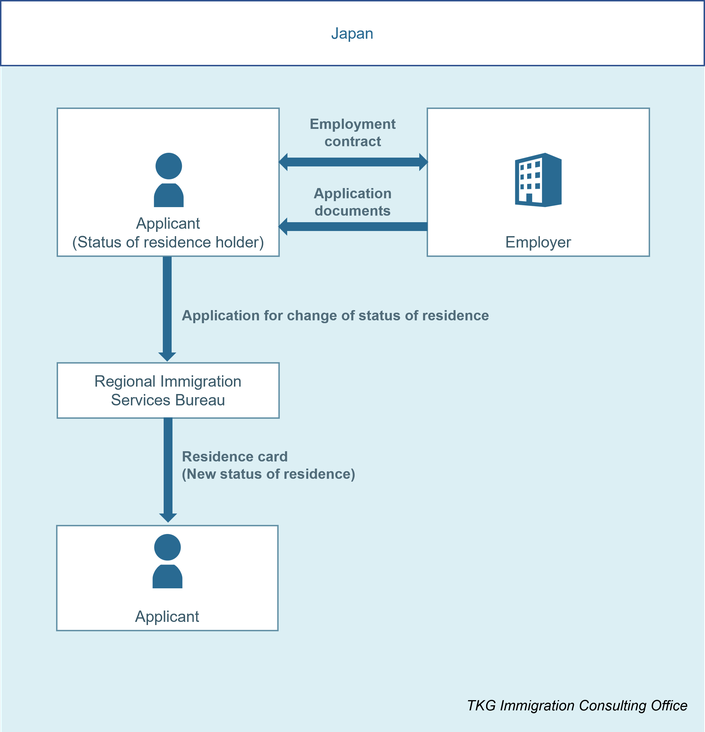
- Apply at the regional immigration services bureau (or branch office) with jurisdiction over your address. Counter hours are generally weekdays 9:00–12:00 and 13:00–16:00. Not sure which office handles your address? See Which immigration office handles your application? (Tokyo bureau and branch offices by area).
- You apply in person, or a gyoseishoshi (行政書士) or lawyer registered with the ISA can file the application on your behalf. In that case you do not need to visit the bureau, but you must be in Japan when the application is filed.
- The documents depend on the status you are changing to. The ISA lists them for each status on its change of status procedure page (Japanese).
- The ISA's standard processing period is 1 to 2 months, longer than for an extension.
Procedures of application for change of status of residence (Working Visa)
3. Applying online
You can also apply through the ISA's Online Residence Application System. You can use it yourself if you are a mid- to long-term resident aged 15 or older; your employer or school (if approved by the ISA) or a gyoseishoshi can also use it on your behalf.
- Do not wait until the last day. The system does not accept applications on the expiry date of your period of stay.
- Your residence card is not stamped. Keep the email confirming that your application was received, and check the ISA's current guidance on how to show that your application is pending.
- Payment is different. For online applications, the fee is paid by convenience store or bank payment after approval, not with revenue stamps. Fee reductions are not available online.
4. Fees from October 1, 2026
For applications received on or after October 1, 2026, the fee depends on the period of stay you are granted, not the period you ask for. Applications received by September 30, 2026 are charged the old fee, even if they are approved later.
| Period of stay granted | At the counter | Online |
|---|---|---|
| 3 months or less | JPY 10,000 | JPY 10,000 + 330 |
| Over 3 months to 6 months | JPY 18,000 | JPY 15,000 + 330 |
| Over 6 months to under 1 year | JPY 25,000 | JPY 21,000 + 330 |
| 1 year | JPY 33,000 | JPY 27,000 + 330 |
| Over 1 year to under 3 years | JPY 48,000 | JPY 42,000 + 330 |
| 3 years to under 5 years | JPY 64,000 | JPY 56,000 + 550 |
| 5 years or more | JPY 75,000 | JPY 65,000 + 550 |
Online amounts are the fee plus a payment processing charge (tax incl.). Source: Immigration Services Agency.
- You pay only if permission is granted. At the counter, you pay with revenue stamps (収入印紙) when you collect your new residence card.
- Applicants who meet certain conditions can have the fee reduced to JPY 10,000. Reductions are handled at the counter only.
For online applications, payment emails come only from addresses ending in @service-dgft.com and @veritrans.jp. Do not click links or pay in response to any other email about visa fees.
For details, see "Paying the new visa fees from October 1, 2026".
5. While your application is under review
If you apply by the expiry date and Immigration has not made a decision by then, you can stay in Japan with your current status of residence until the decision is made, or until 2 months after the expiry date, whichever comes first (the special period, 特例期間). The special period does not apply if your current period of stay is 30 days or less.
It depends on your situation. Unlike an extension, a change of status usually means your current activities are ending. If your current job or studies have already ended (for example, you have left your employer or graduated), you cannot work under your old status during the review. If you are still employed under your current status and are applying because of a future job, you can generally continue your current job within the scope of your current status until the change is granted.
- Part-time work as a student: Permission to work part-time as a student is no longer valid once you are no longer enrolled at your school, for example after graduation.
- Collect your result in time: When you are notified of the result, go and collect it promptly, within the special period.
- Travel abroad: If you leave Japan without re-entry permission, your application is treated as withdrawn. With a re-entry permit, you must return before the special period ends. If possible, wait until you receive your new residence card.
6. Points to watch out for
Changing from Temporary Visitor
A change from "Temporary Visitor (短期滞在)" is granted only when there are unavoidable special circumstances (Immigration Control Act, Article 20(3)). This is because people planning a long stay are expected to obtain a Certificate of Eligibility before entering Japan. In practice, such an application is usually considered only when a Certificate of Eligibility has already been issued for the new status, and even then approval is not guaranteed. In most cases, you should plan to apply for a Certificate of Eligibility and enter Japan with it. See "How to enter Japan with a COE".
Keep your records in order
- Notifications: If you left a job or school, or changed employers, you must notify the ISA within 14 days. See "Changing jobs on a work visa in Japan".
- Students: Attendance, grades and whether you worked beyond the permitted hours can be checked when you change to a work visa.
- Taxes and insurance: Unpaid resident tax, National Health Insurance premiums or pension contributions can count against you. Settle any arrears before you apply.
If your application is refused
- Refused before the expiry date: Ask the immigration bureau for the reason. If the problem can be fixed, you can reapply by the expiry date.
- Refused during the special period: You usually cannot stay with your current status. In many cases you are given a short period to prepare for departure. See "What to do if your visa application is denied in Japan".
7. Frequently asked questions
Can I start my new job before the change is approved?
No. You can start the new activities only after you receive your new residence card. Working in the new job before then can be treated as unauthorized work, for both you and your employer.
I am graduating in March and joining a company in April. When should I apply?
You can apply from December. Apply early, because many students apply at the same time. See "Graduating in 2027? Changing from Student to Engineer/Specialist in Humanities/International Services visa".
I changed jobs. Do I need a change of status?
You need a change of status if your new job falls under a different status of residence, or if your current status is tied to a specific employer, such as "Highly Skilled Professional (i)", "Specified Skilled Worker" or certain types of "Designated Activities". In these cases, you must obtain permission before you start working for the new employer. Otherwise, notify the ISA within 14 days and apply for an extension when your period of stay ends. If you are unsure, a Certificate of Authorized Employment (就労資格証明書) can confirm whether your new job fits your current status.
Can I change my status if my period of stay has already expired?
No. You must apply while your current period of stay is still valid. If it has expired, go to the immigration bureau immediately and explain your situation.
8. Our support and fees
- Eligibility check: We confirm whether your new activities fit the status you are applying for, and what needs to be explained.
- Contract: We sign the contract and issue the invoice online.
- Document preparation: We give you a document list for your case and check the documents you prepare. We draft the application form and, depending on your case, other documents such as a statement of reasons or explanatory letters, for you to review.
- Application: We file the application on your behalf, at the immigration bureau or online.
- Result: You receive your new residence card.
| Service | Standard fee (tax incl.) |
|---|---|
| Change of status of residence | JPY 165,000–330,000 |
Standard fee, depending on the status of residence. Complex cases are quoted individually. Government fees and actual costs are charged separately. See "Fees" for the fee for each status.
Please note that no one can guarantee approval: the decision is made by the Immigration Services Agency. We help you present your situation accurately.
If you prepare and submit the application yourself, our Document Check lets a certified gyoseishoshi review your documents before you submit and send you a written report in English (from JPY 66,000, tax incl.).
Free re-application: If an application we filed is refused, we will handle one re-application for the same status of residence free of charge (no additional professional fee), provided you request it within one month of the date of the notice. Government fees and actual costs are not included.
Hearing the reason for the refusal: We can go with you to the immigration bureau to hear the reason for the refusal, free of charge if we filed the original application. Actual travel costs are charged separately. See "Fees" for details, including when another office or you filed the application.
What to include in your inquiry
In our reply, we tell you whether we can help and which of our services fits. Please include the following so that we can judge this:
- Your current status of residence and its expiry date
- What you plan to do in Japan (for example, the new job and employer, school, or marriage), and when it starts
- Your educational background and work experience, if you are changing to a work visa
- Any past visa refusals or overstays
Please do not send copies of passports or other identity documents with your inquiry. Send an Inquiry
Sources
- Immigration Services Agency of Japan, "在留資格変更許可申請" (Japanese)
- Immigration Services Agency of Japan, notice on the revised fees and online payment from October 1, 2026 (Japanese)
- Immigration Services Agency of Japan, "在留資格の変更、在留期間の更新許可のガイドライン" (Japanese)
- Immigration Services Agency of Japan, "在留申請のオンライン手続" (Japanese)
- Immigration Control and Refugee Recognition Act, Articles 20 and 22-4
Disclaimer: This page is provided for general information only and is not legal advice on any individual case. The information is based on sources available as of October 14, 2026. Laws, guidelines and their application may change without notice. TKG Immigration Consulting Office accepts no liability for any loss or damage arising from the use of this information. In case of any difference between our English descriptions and the original Japanese texts, the Japanese texts prevail.