

Contents
Key points
- To come to Japan for a mid- to long-term stay (for work, study or to join family), you generally need a Certificate of Eligibility (COE) before applying for a visa.
- The application is filed in Japan, usually by your employer, school or family member in Japan, or by a gyoseishoshi on their behalf. There is no government fee, and the standard processing period is 1 to 3 months.
- A COE can be received by email. It is valid for 3 months: you must apply for a visa and enter Japan within that time.
- A COE does not guarantee a visa or entry. If your circumstances change, you may be refused.
1. What a COE is
Foreign nationals wishing to land in Japan must apply for landing permission from the immigration inspector at the airport or port where they intend to land and undergo a landing examination. If the inspector finds that they meet the conditions for landing, landing is permitted and they are granted a status of residence and period of stay (see "Difference between Visa and Status of Residence").
It is difficult to prove that you meet those conditions in a short time at the airport. A Certificate of Eligibility (在留資格認定証明書, COE) is issued in advance by the Immigration Services Agency (ISA) and certifies that your planned activities in Japan meet the conditions for landing under the Immigration Control Act.
When you come to Japan for the first time for a mid- to long-term stay, you are, in principle, expected to obtain a COE in advance. The only exception among common statuses is "Temporary Visitor", which is not covered by the COE system.
2. Who applies, and how
Who files the application
- The application is filed in Japan. Since most applicants are abroad, it is usually filed by an agent in Japan, such as staff of your employer or school, or a family member living in Japan (for example, your Japanese spouse).
- A gyoseishoshi (行政書士) or lawyer registered with the ISA can file the application on behalf of you or your agent.
- The application is filed at the regional immigration services bureau with jurisdiction over the place where you will live or, when an agent applies, over the location of your employer or other receiving organization. It can also be filed online. Applications by post are not accepted.
Documents, fee and processing time
- The documents depend on the status of residence you will hold. The ISA lists them for each status on its COE procedure page (Japanese).
- There is no government fee for a COE. (A visa fee may be charged at the Japanese embassy or consulate, depending on your nationality.)
- The ISA's standard processing period is 1 to 3 months. Apply well before your planned start date.
- Electronic COE: Since March 2023, a COE can be issued by email instead of on paper. The email can be forwarded to you abroad, and you can show it on your smartphone when you apply for a visa.
Procedures of entering Japan with a COE (Working Visa)
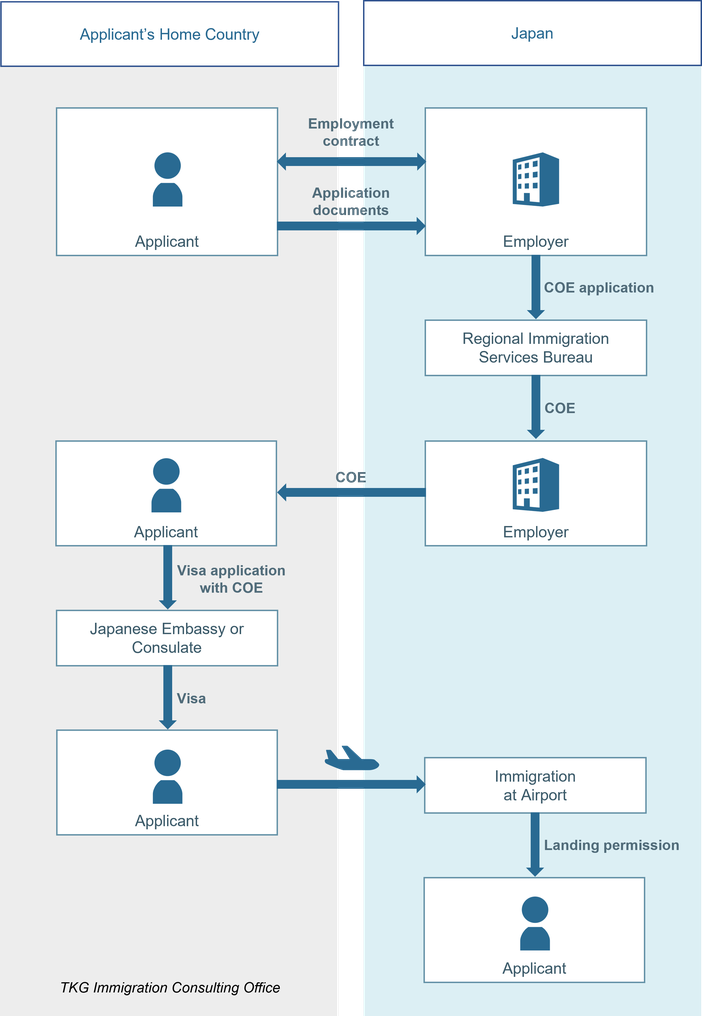
3. After the COE is issued: visa and entry
- Apply for a visa. Take your passport and the COE (the email, a printout or the paper certificate) to the Japanese embassy or consulate in your country of residence. Processing times and requirements vary by embassy, so check with the embassy in advance.
- Enter Japan within 3 months. A COE is valid for 3 months from the date of issue. You must apply for landing at a Japanese airport or port within that period. The validity of your visa is a separate matter.
- Landing examination. At the airport, the immigration inspector grants your status of residence and period of stay. At major airports (New Chitose, Sendai, Narita, Haneda, Chubu, Kansai, Kobe, Hiroshima, Fukuoka and Naha), your residence card is issued on the spot. At other ports of entry, it is sent to you by mail after you register your address.
- Register your address. Within 14 days of deciding where you will live, register your address at the municipal office (city or ward office), bringing your residence card. If you do not register within 90 days without a legitimate reason, your status of residence may be cancelled.
4. Points to watch out for
The embassy can refuse a visa, and the immigration inspector can refuse landing, if your circumstances have changed after the COE was issued (for example, if your job offer was withdrawn or your marriage has broken down) or if other problems are found. Tell the person who applied for your COE about any changes before you travel.
- Do not let the COE expire. If you cannot enter Japan within 3 months, the COE becomes invalid and a new application is needed. If you decide not to come after receiving a paper COE, return it to the immigration office that issued it.
- Tuberculosis screening: Nationals of certain countries (currently the Philippines, Nepal and Vietnam, with Indonesia planned to be added for applications filed on or after January 4, 2027, and Myanmar and China to follow) who plan a mid- to long-term stay must submit a certificate showing they do not have active tuberculosis, issued by a designated clinic in their country. When the COE is applied for in Japan, the certificate is submitted with the COE application. Some categories are exempt for the time being. For who is covered, exemptions and timing, see our article on Japan's pre-entry tuberculosis screening.
- Applying while you are in Japan as a visitor: A COE can be applied for while you are in Japan on a short-term stay, but changing from "Temporary Visitor" to another status is allowed only in limited cases. In most cases, you should plan to leave Japan and enter again with the COE. See "Change of Status of Residence".
- If the COE is not issued: There is no formal appeal. Ask the immigration bureau for the reason. If the problem can be fixed, for example with additional documents or explanations, you can apply again.
5. "Temporary Visitor" status
The status of residence "Temporary Visitor (短期滞在)" is not covered by the COE system. It allows foreign nationals to engage in non-working activities such as tourism, recuperation, sports, visits to relatives, field trips, short courses or meetings, and business liaison. Unless you are a national of a country exempt from visa requirements, you must obtain a "Short-term Stay" visa at a Japanese embassy or consulate before coming to Japan.
6. Frequently asked questions
How long does the whole process take?
Allow at least 2 to 4 months in total: preparing the documents, 1 to 3 months for the COE, and then the time needed for the visa at the embassy. Complex cases can take longer.
Can my family come with me?
Yes, if they are eligible for a status of residence such as "Dependent (家族滞在)". Their COE applications can be filed at the same time as yours, or after you have started living in Japan.
My COE expired before I could travel. What should I do?
A new COE application is needed. Contact your employer, school or family member in Japan, or the office that handled the application, as soon as possible.
Does a COE allow me to work in Japan?
Not by itself. You can engage in the activities of your status of residence only after you have entered Japan with the status granted at the airport.
7. Our support and fees
- Eligibility check: We confirm whether your planned activities in Japan fit the status of residence, and what needs to be explained.
- Contract: We sign the contract and issue the invoice online.
- Document preparation: We give you a document list for your case and check the documents you prepare. We draft the application form and, depending on your case, other documents such as a statement of reasons or explanatory letters, for you to review.
- Application: We file the application on your behalf, at the immigration bureau or online.
- Result: You receive the COE (by email or on paper) to use for your visa application.
| Service | Standard fee (tax incl.) |
|---|---|
| Certificate of Eligibility (COE) | JPY 165,000–330,000 |
Standard fee, depending on the status of residence. Complex cases are quoted individually. Government fees and actual costs are charged separately. See "Fees" for the fee for each status.
Please note that no one can guarantee approval: the decision is made by the Immigration Services Agency. We help you present your situation accurately.
Free re-application: If an application we filed is refused, we will handle one re-application for the same status of residence free of charge (no additional professional fee), provided you request it within one month of the date of the notice. Government fees and actual costs are not included.
Hearing the reason for the refusal: We can go with you to the immigration bureau to hear the reason for the refusal, free of charge if we filed the original application. Actual travel costs are charged separately. See "Fees" for details, including when another office or you filed the application.
What to include in your inquiry
In our reply, we tell you whether we can help and which of our services fits. Please include the following so that we can judge this:
- Your nationality and where you live now
- What you plan to do in Japan (for example, the job and employer, school, or family you will join), and when you would like to arrive
- Your educational background and work experience, if you will work in Japan
- Any past visa refusals, overstays or deportations
Please do not send copies of passports or other identity documents with your inquiry. Send an Inquiry
Sources
- Immigration Services Agency of Japan, "在留資格認定証明書交付申請" (Japanese)
- Immigration Services Agency of Japan, "在留資格認定証明書の電子化について" (Japanese)
- Immigration Services Agency of Japan, "出入国審査・在留審査Q&A" (Japanese)
- Immigration Services Agency of Japan, overview of the pre-entry tuberculosis screening (Japanese, PDF)
- Immigration Control and Refugee Recognition Act, Articles 7-2, 19-7 and 22-4
Disclaimer: This page is provided for general information only and is not legal advice on any individual case. The information is based on sources available as of October 14, 2026. Laws, guidelines and their application may change without notice. TKG Immigration Consulting Office accepts no liability for any loss or damage arising from the use of this information. In case of any difference between our English descriptions and the original Japanese texts, the Japanese texts prevail.