

Contents
Update (October 2026): The Immigration Services Agency (ISA) officially revised the permanent residence guidelines on October 1, 2026. Besides the 5-year visa requirement explained in this article, the revised guidelines add new requirements:
- Already in effect: household income compared with the average income of Japanese households of the same size. This also applies to applications filed on or after April 1, 2026 that were still under review on October 1, 2026.
- For applications on or after April 1, 2027: pension, Japanese language (B1 level), understanding of Japan’s rules, school attendance of children, stricter review of past payment records, and longer periods for spouses (5 years of marriage and 3 years of residence) and children (3 years of residence) of Japanese nationals and permanent residents
See our article Japan’s permanent residence guidelines have been revised: what changed on October 1, 2026 and our Permanent Residence page for details.
Japan’s Immigration Services Agency revised its guidelines for permanent residence (PR) on February 24, 2026. Starting April 1, 2027, the requirement on an applicant’s “period of stay” becomes stricter.
What is changing
Under the Immigration Control Act, the “longest period of stay” required for a PR application is technically defined as 5 years.
In practice, however, the Ministry of Justice has applied this rule flexibly: holding a 3-year visa has been considered enough to meet the “longest period of stay” requirement.
This flexible practice is coming to an end. On February 24, 2026, the government announced that it will begin strictly enforcing the 5-year requirement from April 1, 2027. The guidelines revised on October 1, 2026 keep this rule.
Please note that whether you are granted a 5-year visa is at the discretion of the ISA, based on factors such as the stability of your residence and your tax record.
Transition timeline and transitional measure
What matters is the date you submit your PR application. The guidelines revised on October 1, 2026 set out the rules as follows.
| Application date | Is a 3-year visa accepted as the “longest period of stay”? |
|---|---|
| Until March 31, 2027 | Yes, regardless of when the decision is made. |
| On or after April 1, 2027 | In principle, no. A 5-year visa is required, except under the transitional measure below. |
Transitional measure for applications on or after April 1, 2027
A 3-year visa is still treated as the “longest period of stay” only if all of the following apply:
- You hold a 3-year visa as of March 31, 2027.
- The application is your first PR application on or after April 1, 2027.
- The decision on your application is made between April 1, 2027 and the expiry date of that 3-year visa.
Note: PR applications often take many months to process. If your 3-year visa expires soon after April 2027, the decision may not be made in time, and the transitional measure would no longer apply.
Am I affected? What to do now
| Your situation | What it means and what to do |
|---|---|
| You already hold a 5-year visa | You meet the “longest period of stay” requirement. Check the other requirements, including the new ones in the revised guidelines. |
| You hold a 3-year visa and meet the other requirements now | An application submitted by March 31, 2027 is accepted with a 3-year visa. Note that the new household income standard already applies to applications filed on or after April 1, 2026. |
| You hold a 3-year visa on March 31, 2027 and plan to apply later | Only your first application counts under the transitional measure, and the decision must come before your visa expires. Apply well before the expiry date. |
| You hold a 1-year visa, or you will get a 3-year visa after April 1, 2027 | You will generally need a 5-year visa. Focus on meeting the conditions for a 5-year period of stay at your next renewal (see the FAQ below). |
Do not rush an application only to beat the April 2027 deadline. If other requirements are not met, the application may be denied, and a denial stays on your immigration record. Depending on the reason for the denial (for example, unpaid taxes or social insurance), you may also be given a shorter period of stay than your current one at your next renewal.
Permanent residence approval rate
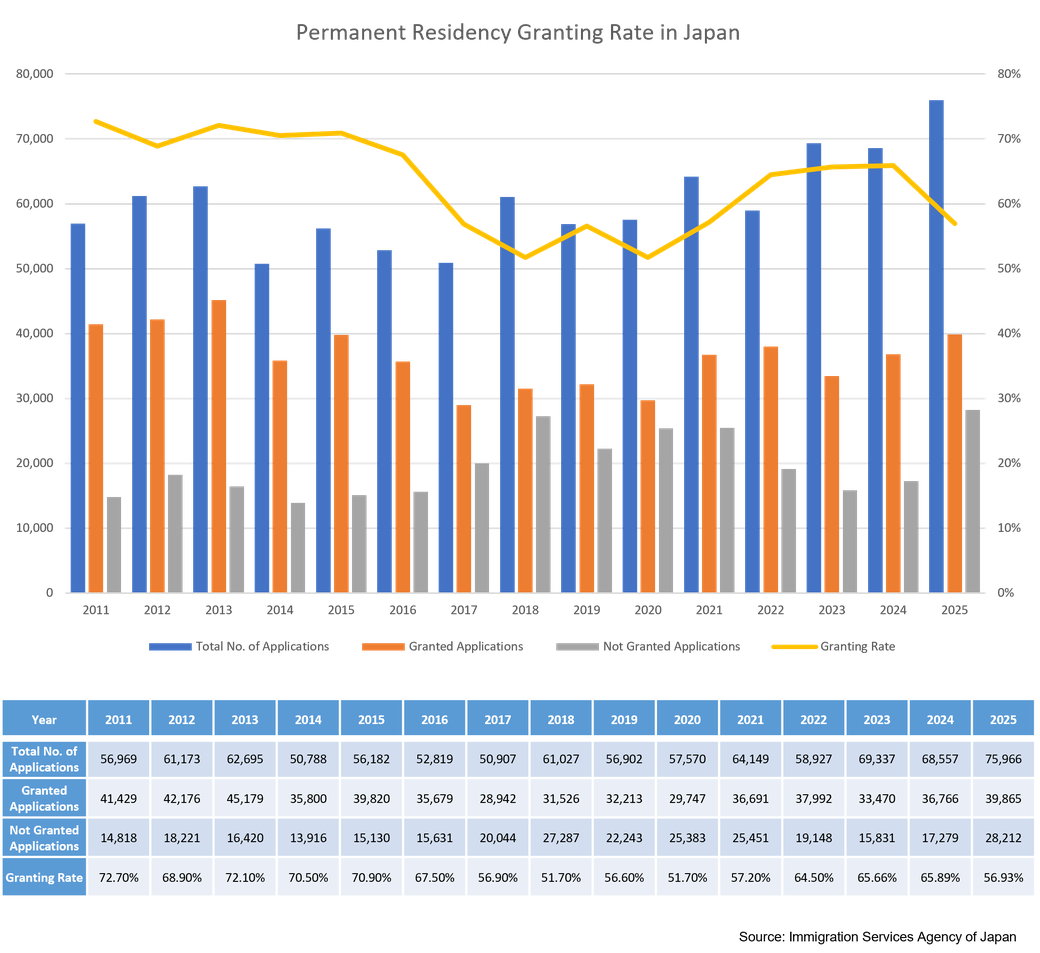
The number of people granted permanent residence stayed between about 50,000 and 60,000 a year from 2011 to 2022, and has been rising since 2023.
The approval rate stayed around 70% until 2016, then fell sharply to 56.9% in 2017. It recovered between 2022 and 2024, but dropped again to 56.93% in 2025.
Given these trends and the tightening rules, it is essential to prepare your application with great care. You can start with our eligibility checklists.
Frequently asked questions
How can I get a 5-year visa when I renew?
The period of stay is decided by the ISA at its discretion. Factors usually considered include the stability of your employer or business, your expected period of work in Japan, compliance with notification obligations (such as reporting a change of address or employer), full and timely payment of taxes and social insurance, and school attendance of your children.
Can I request a 5-year period of stay without waiting for renewal?
In general, the period of stay can only change when you renew your visa. You can apply for an extension of stay from about three months before your current period of stay expires.
Does this apply to spouses of Japanese nationals or permanent residents?
Yes. The “longest period of stay” requirement applies to spouses as well, and the longest period for a spouse visa is 5 years. In addition, for applications on or after April 1, 2027, the revised guidelines require 5 years of marriage and 3 years of continuous residence in Japan (previously 3 years and 1 year). Children of Japanese nationals and permanent residents will need 3 years of continuous residence (previously 1 year). See how to apply for permanent residence as a spouse.
What about Highly Skilled Professional (HSP) visa holders?
The HSP (i) visa is granted for 5 years, so HSP holders usually meet this requirement. The HSP fast track to permanent residence (3 years with 70 points, 1 year with 80 points) is maintained in the revised guidelines. HSP holders and their families do not need to show B1-level Japanese, but they are not exempt from the new income and pension requirements.
If I apply before April 2027, can I avoid the new requirements?
Only partly. The pension, Japanese language and other new requirements apply to applications on or after April 1, 2027. The household income standard, however, already applies to applications filed on or after April 1, 2026, including those that were still under review on October 1, 2026.
Related pages
- Japan’s permanent residence guidelines have been revised: what changed on October 1, 2026
- Permanent residence eligibility checklists by visa type
- Revision of the permanent residence guidelines (October 2026)
- How to apply for permanent residence: working visa holders
- How to apply for permanent residence: spouses of Japanese nationals and permanent residents
This article provides general information and is not legal advice. It is based on the ISA’s permanent residence guidelines revised on February 24, 2026 and October 1, 2026 (last updated October 2026). Details may change, so please check the Immigration Services Agency’s website before you apply.